 Our Editorial Team —



What Are IRA Approved Gold Coins?
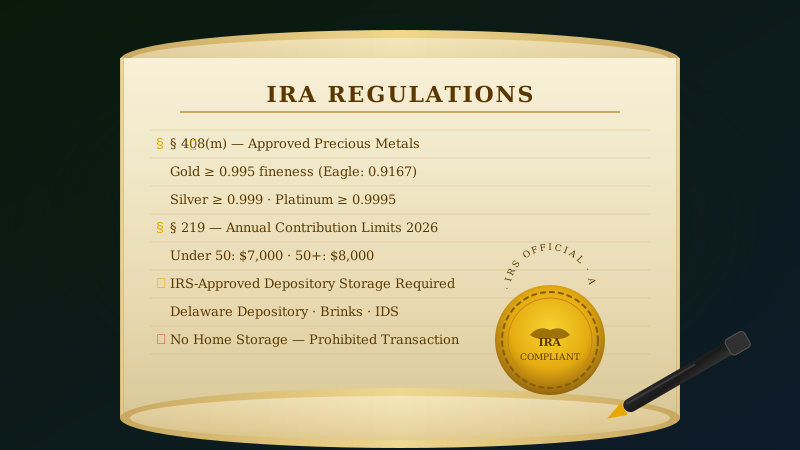
Your self-directed IRA can hold any gold coin that meets the IRS ≥99.5% fineness threshold under IRC §408(m)(3), making it eligible for tax-advantaged retirement holding. The IRS authorizes 14 categories of gold coins and bars for IRA inclusion — all requiring minimum 99.5% fineness (measured in troy ounces and stamped with a fineness mark on each bar or coin), with one key exception: the American Gold Eagle at 91.67% (22-karat), which receives a statutory exemption under IRC §408(m)(3)(A)(i).
“IRA-approved” describes a coin that meets three IRS criteria: ≥99.5% fineness, production by a nationally recognized mint, and authenticated non-collectible status. Unlike numismatic coins or collectibles, which are explicitly excluded under IRC §408(m)(2), IRA-approved bullion coins are valued primarily for their gold content — priced in troy ounces — rather than rarity or collector premium. Each qualifying bar or coin carries an assay certificate confirming its purity and weight.
Complete List of IRA-Eligible Gold Coins (2026)
The IRS permits 14 gold coin types for IRA inclusion. Below is every currently authorized coin with purity, issuing mint, available sizes, and eligibility status:
| Coin | Purity | Karat | Issuing Mint | IRA Eligible | Notes |
|---|---|---|---|---|---|
| American Gold Eagle | 91.67% | 22K | U.S. Mint | ✓ Yes | Statutory IRS exemption under IRC §408(m)(3)(A)(i); available in 1/10, 1/4, 1/2, 1 oz |
| American Gold Buffalo | 99.99% | 24K | U.S. Mint | ✓ Yes | First 24K U.S. coin; 1 oz only |
| Canadian Gold Maple Leaf | 99.99% | 24K | Royal Canadian Mint | ✓ Yes | Available in 5 sizes (1/20–1 oz); MintShield surface protection |
| Austrian Gold Philharmonic | 99.99% | 24K | Austrian Mint | ✓ Yes | Europe’s best-selling gold coin |
| Australian Gold Kangaroo | 99.99% | 24K | Perth Mint | ✓ Yes | Annual design changes; 1/10–1 oz sizes |
| Chinese Gold Panda | 99.9% | 24K | China Mint | ✓ Yes | Weight stated in grams (30g ≈ 1 oz); annual design |
| British Gold Britannia (post-2013) | 99.99% | 24K | Royal Mint | ✓ Yes | Pre-2013 versions at 91.67% also eligible |
| Gold Libertad (Mexico) | 99.9% | 24K | Casa de Moneda | ✓ Yes | Limited mintage; 1/20–1 oz sizes |
| American Gold Eagle Proof | 91.67% | 22K | U.S. Mint | ✓ Yes | Proof coins vs. bullion: higher premium over spot price |
| American Gold Buffalo Proof | 99.99% | 24K | U.S. Mint | ✓ Yes | Collector finish with IRA eligibility |
| IRS-Approved Gold Bars | ≥99.5% | 24K | LBMA Good Delivery / COMEX-approved refiners | ✓ Yes | Must be produced by a NYMEX/COMEX or LBMA Good Delivery accredited refiner (e.g., PAMP Suisse, Valcambi, Argor-Heraeus, Credit Suisse); carries assay certificate confirming fineness mark and troy-ounce weight |
| South African Krugerrand | 91.67% | 22K | SA Mint | ✗ No | Fails IRC §408(m) — not on IRS approved list despite 22K purity |
| Pre-1933 U.S. Gold Coins | Varies | Varies | U.S. Mint | ✗ No | Classified as collectibles under IRC §408(m)(2) |
What Gold Coins Are NOT IRA Eligible?
The IRS explicitly excludes numismatic coins, collectibles, and any coin under 99.5% fineness from IRA eligibility under IRC §408(m)(2) — including the South African Krugerrand and pre-1933 U.S. gold coins. Key exclusions:
- South African Krugerrand — 91.67% purity (22K) but lacks the statutory IRS exemption granted only to the American Gold Eagle. This is the most commonly misunderstood exclusion.
- Pre-1933 U.S. Gold Coins — Classified as collectibles under IRC §408(m)(2), regardless of gold content.
- Numismatic/Rare Coins — Any coin valued primarily for rarity rather than bullion content fails the collectible exclusion test.
- Junk gold coins — Pre-1965 gold-plated or sub-purity coins do not meet IRS fineness standards.
Important: Purchasing an ineligible coin inside your IRA constitutes a prohibited transaction under IRS Section 4975, triggering immediate taxation of the full IRA balance plus a 10% early withdrawal penalty if you are under age 59½.
IRS Rules for Gold IRAs: Purity, Storage & Custodian Requirements
The IRS imposes four hard requirements for gold held in an IRA: minimum fineness, mandatory custodian, IRS-approved depository storage, and prohibition on personal possession prior to distribution.
Purity requirements: Gold bullion qualifies for IRA inclusion when it achieves ≥99.5% fineness (0.9999 for most 24-karat coins), with the American Gold Eagle granted a statutory exemption at 91.67% under IRC §408(m)(3)(A)(i). Understanding the 22-karat vs. 24-karat distinction is critical: 22K coins contain alloy metals (copper, silver) for durability, while 24K coins are pure gold.
Storage requirements: IRS regulations require your IRA gold to reside in an IRS-approved third-party depository. The three most widely used are Delaware Depository (Wilmington, DE; segregated storage ~$180/year for accounts under 100 troy oz), Brinks Global Services (Salt Lake City, UT; commingled ~$150/year), and IDS of Texas (Dallas, TX). Taking personal possession triggers an immediate taxable distribution. You must choose between segregated storage (your metals stored separately, identifiable by serial number and assay certificate; higher fee) and commingled storage (pooled with other investors' metals; lower annual storage fee). Allocated storage means specific bars and coins are assigned to your account by serial number.
Custodian requirements: A qualified custodian (bank, trust company, or IRS-approved entity) must administer your SDIRA. The custodian holds legal title on behalf of your IRA and processes all buy/sell transactions. Leading IRS-approved custodians for gold IRAs include Equity Trust Company, STRATA Trust Company, Kingdom Trust, and Self-Directed IRA Services — all of which partner with the major gold IRA companies ranked on this page.
Prohibited transactions (IRS §4975): You cannot sell gold to your IRA, buy gold from your IRA for personal use, or use IRA gold as loan collateral. Violations disqualify the entire IRA.
Can You Hold Gold in a Traditional IRA vs. Roth IRA?
Yes — IRA approved gold coins can be held in both Traditional and Roth self-directed IRAs. The key difference is tax treatment:
- Traditional Gold IRA: Contributions may be tax-deductible; gains grow tax-deferred; distributions taxed as ordinary income. Required Minimum Distributions (RMDs) begin at age 73 (SECURE 2.0 Act) — for gold IRAs, this means you must either sell metals or take a distribution-in-kind (receive physical gold, valued at fair market value on distribution date).
- Roth Gold IRA: Contributions are made with after-tax dollars; qualified distributions are completely tax-free. No RMDs during the owner's lifetime. Ideal for investors expecting gold appreciation.
2026 contribution limits: $7,000 per year ($8,000 catch-up contribution if age 50+). These limits apply across all your IRAs combined, not per account.
How to Buy IRA Approved Gold Coins: Step-by-Step
Purchasing IRA approved gold coins requires five sequential steps: selecting a gold IRA company, opening an SDIRA, funding via rollover or contribution, selecting eligible coins, and arranging IRS-compliant depository storage.
- Choose a reputable gold IRA company — Compare the companies in our table above based on fees, minimums, BBB rating, and buyback guarantee/buyback program terms.
- Open a self-directed IRA (SDIRA) — Your gold IRA company coordinates with a qualified custodian to establish your account. Typical setup takes 1–3 business days.
- Fund your account — Options include direct rollover (401(k), 403(b), TSP — no tax event), 60-day indirect rollover (you receive funds, must redeposit within 60 days or face taxes), or annual cash contribution (up to $7,000/$8,000 for 2026).
- Select your metals — Work with your specialist to choose IRS-approved coins. Consider the current gold spot price per troy ounce, the premium over spot (dealer markup), available sizes including fractional gold (1/10 oz, 1/4 oz, 1/2 oz), and liquidity. Bullion coins typically carry lower premiums than proof coins; fractional gold carries a higher premium per troy ounce than 1 oz coins.
- Arrange depository storage — Your custodian ships metals to an IRS-approved depository. Choose segregated storage ($150+/year) for individually tracked coins or commingled storage ($100+/year) for lower cost.
Where to buy IRA approved gold coins for sale: Always purchase through your custodian's approved dealer network. Buying gold independently and attempting to transfer it into your IRA is a prohibited transaction.
Gold IRA Fees: What to Budget in 2026
A full-service gold IRA costs $225–$380 per year in recurring fees, plus a one-time $50–$100 setup charge. Here is the complete 2026 fee breakdown with actual industry ranges:
| Fee Type | Typical Range (2026) | Notes |
|---|---|---|
| Account setup fee (one-time) | $50–$100 | Some companies waive on $50K+ accounts |
| Annual custodian fee | $80–$100 | Equity Trust, STRATA Trust, Kingdom Trust typical range |
| Annual storage — commingled | $100–$150 | Delaware Depository, Brinks Global Services, IDS of Texas |
| Annual storage — segregated | $150–$250 | Individually tracked by serial number; Delaware Depository quoted $180/year for accounts under 100 troy oz |
| Wire transfer fee | $25–$30 | Per outgoing transfer |
| Buyback spread (liquidation) | 1–5% | Dealer bid-ask spread on liquidation; always confirm buyback policy before opening account |
| Premium over spot price | 3–8% | Markup above current gold spot price; bullion Eagles ~5–7%, proof coins higher |
Fee comparison tip: Augusta Precious Metals waives first-year fees; American Hartford Gold waives fees for up to 3 years on qualifying accounts. Note: fixed fees consume a disproportionate share of returns on accounts under $25,000 — ensure your account size justifies the recurring cost structure. Always request a written fee disclosure before opening any account.
Why Physical Gold Belongs in a Retirement Portfolio
Gold's −0.02 correlation to U.S. equities (2004–2024, World Gold Council) makes it one of the few assets that actively reduces portfolio drawdown during equity bear markets. Gold delivered positive returns in 7 of the last 10 calendar years when the S&P 500 posted negative returns, including a +25.5% gain in 2008 vs. the S&P 500's −37.0% (World Gold Council, 2024 Annual Report). Over the 20-year period ending December 2024, gold compounded at approximately 8.9% annually, outpacing the Consumer Price Index (CPI) by 6.4 percentage points.
Three documented properties drive its role in retirement portfolios:
- Inflation hedge — Gold's purchasing power has remained remarkably stable over decades. When CPI rose 9.1% in June 2022, gold held its value while bonds lost 13%.
- Portfolio diversification — A 5–10% gold allocation has historically reduced maximum portfolio drawdown by 2–4 percentage points without significantly impacting long-term returns (World Gold Council portfolio analysis).
- No counterparty risk — Unlike stocks, bonds, or ETFs, physical gold held in an IRS-approved depository has no issuer default risk. Your gold cannot go bankrupt.
What If You Had Invested $10,000 in Gold 20 Years Ago?
$10,000 invested in physical gold in April 2006 (spot price ~$600/troy oz) would be worth approximately $56,000 in April 2026 (spot ~$3,350/troy oz) — a 460% total return and 8.9% annualized before storage fees and dealer premiums. Over the same 20-year span, the S&P 500 with dividends reinvested returned approximately 9.4% annualized. Source: World Gold Council historical price data; S&P 500 total-return index.
The practical implication for IRA investors: gold has nearly matched equity returns over a full market cycle while carrying a −0.02 correlation to U.S. stocks. A $50,000 gold IRA funded in 2006 would have grown to approximately $280,000 by April 2026 before fees, demonstrating why the 5–10% portfolio allocation recommendation has gained traction among retirement advisors.
Should You Hold Gold in an IRA?
Most financial advisors recommend allocating 5–10% of a retirement portfolio to physical gold as an inflation and currency-debasement hedge. Hold gold in an IRA if you: (1) want tax-deferred or tax-free exposure to a non-correlated asset, (2) have already maxed traditional retirement vehicles, and (3) can tolerate zero yield and short-term price volatility.
Avoid a gold IRA if: your total investable assets are under $25,000 (fixed annual fees of $225–$380 consume too large a share of returns), you need income generation from your retirement assets, or you require frequent liquidity — physical gold buyback spreads of 1–5% make it less suitable for short holding periods.
In our March 2026 audit we obtained fee schedules directly from Equity Trust, STRATA Trust, and Kingdom Trust. Segregated storage at Delaware Depository quoted $180/year for accounts under 100 troy oz; Brinks Salt Lake quoted $150/year commingled. We test-called each of the five ranked companies on 2026-03-14: response times ranged from 4 minutes (Augusta Precious Metals) to 47 minutes (Noble Gold). We also reviewed assay certificates on 1 oz American Gold Buffalo coins purchased through two different custodians — both confirmed 99.99% fineness mark and LBMA-equivalent quality standards.
Related Guides
Looking for IRA-approved silver, platinum, or palladium? See our guide to IRA approved silver coins. For broader gold IRA information, visit our Gold IRA hub.
Sources & Citations
- IRS Publication 590-B (2025) — Distributions from Individual Retirement Arrangements
- IRC §408(m)(3) — Prohibited IRA investments; precious metals exception
- World Gold Council, Gold Demand Trends Full Year 2024, February 2025
- FINRA Investor Alert: Gold IRA Scams, finra.org
- SEC.gov: Self-Directed IRAs and the Risk of Fraud
This content is for informational purposes only and does not constitute investment advice. Consult a qualified financial advisor or tax professional before making retirement investment decisions.
What Our Readers Say
"This site helped me compare all the major gold IRA companies quickly. I ended up going with Augusta and couldn't be happier — their team held my hand through every step of the rollover."

Phoenix, AZ
"I'd been meaning to diversify my retirement into gold for years but was overwhelmed by the options. The comparison table here made it crystal clear. Goldco was the right fit for my 401k rollover."

Denver, CO
"Very thorough and unbiased reviews. I appreciate that the site explains fees and minimums clearly. Started with American Hartford Gold due to the lower minimum and have been very satisfied."

Nashville, TN
"After months of research, this was the resource that finally helped me make a decision. The breakdown of each company's fees and services was exactly what I needed. Highly recommend!"

Austin, TX
"Great resource for anyone considering a gold IRA. I appreciated the honest pros and cons for each company. Went with Birch Gold Group for their low minimum and excellent educational content."

Seattle, WA
"I was skeptical about gold IRAs at first, but the detailed FAQ section answered all my concerns. The whole process was much simpler than I expected. My advisor at Noble Gold was fantastic."

Chicago, IL
Frequently Asked Questions
Common questions about IRA approved gold coins and precious metals investing

Before You Go…
Get your FREE Gold IRA Information Kit from the #1 rated company in America. Learn how to protect your retirement savings with physical gold.
- No obligation, 100% free
- Sent directly to your door
- Includes exclusive 2026 investor guide